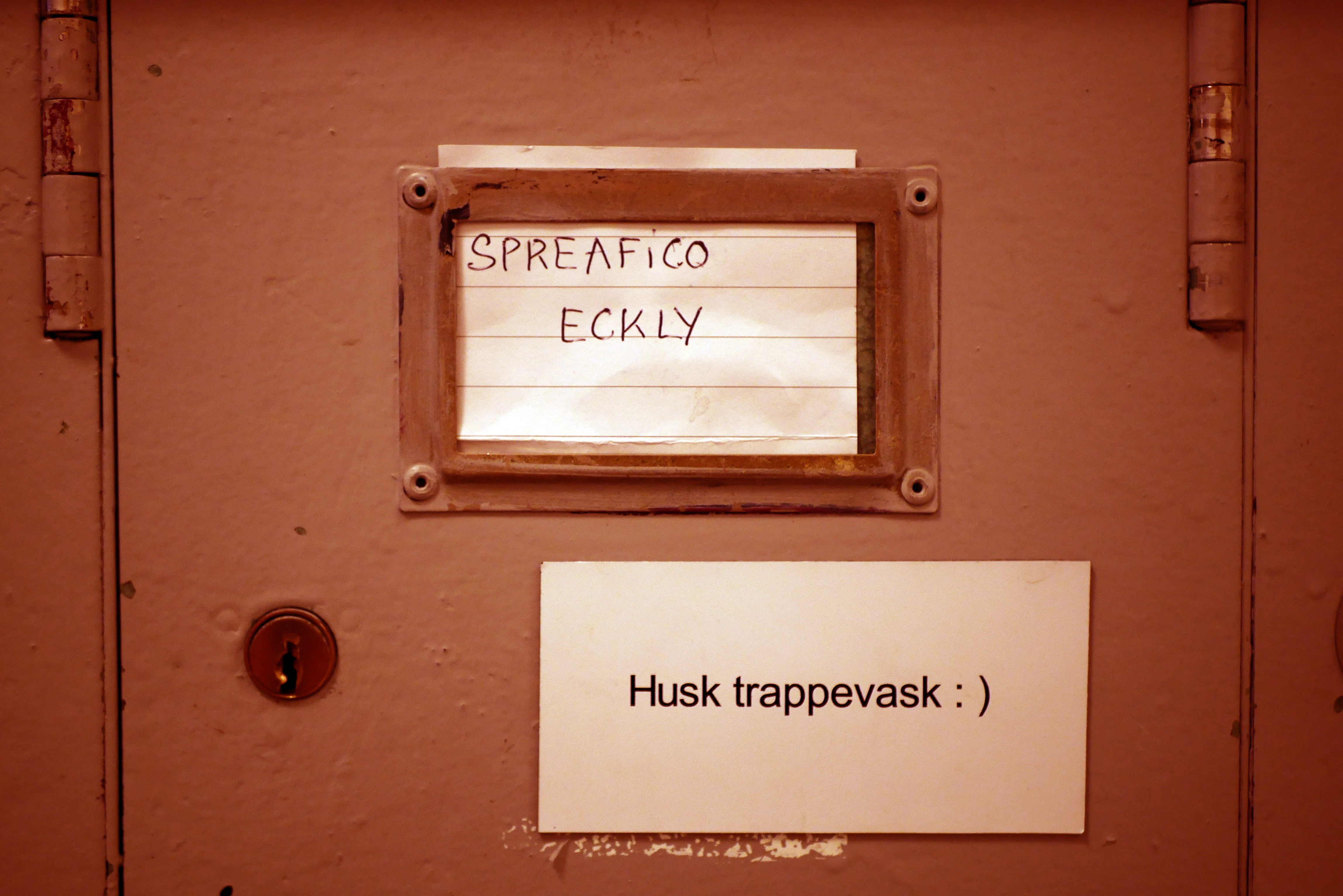
Spreafico Eckly was founded by Andrea Spreafico in Bergen in 2013 in the apartment of Andrea Spreafico and Caroline Eckly, where it still has its HQ – hence the name.
Directed by Andrea, the company has never had a fixed group of collaborators, but the team of each piece has been decided accordingly to the needs of the concept. Nonetheless some patterns have repeated themselves and Matteo Fargion (London) and Theatre Replacement (Vancouver) have become important partners in the development of the artistic discourse of the company. The forms of expression are different every time (songs, choreographies, theory, drama, opera, interactive situations). Most of Spreafico Eckly's works treat one element from the past in order to re-consider the way we usually watch at our present time. They are thought as breaks (pauses) in the constant flow of information, as ways to reconsider our present without "taking position" against it, as models of an alternative way of thinking our time.
Before working as an artist Andrea Spreafico has been a Nietzsche scholar (PhD at University of Bologna, Italy and Reims, France in 2006). He's currently Associate Professor in performance at the Bergen School of Architecture.
Performances
2026
- 18–19.11 Franz (Purgatorio XXVII-XXXIII), Rosendal Teater, Trondheim
- 28.10 Franz (Purgatorio XXVII-XXXIII), Teatro Rasi, Ravenna
- 15.03 Franz (Purgatorio XXVII-XXXIII), Borealis Festival, Bergen
2025
- 22–23.10 Mario & Raoul, Meteor Festival, Bergen
- 20–22.09 Durante and the Bad Loves (Purgatorio X-XXVI), Teatro Rasi, Ravenna
- 10–11.01 And We Cheerfully Put the Gods to Death, Cocktail Lounge, New York City
2024
- 05–07.09 And We Cheerfully Put the Gods to Death, Bit Teatergarasjen, Bergen
- 12–13.09 And We Cheerfully Put the Gods to Death, Rimi/Imir, Stavanger
- 13–14.11 And We Cheerfully Put the Gods to Death, Rosendal Teater, Trondheim
2023
- 25–26.10 Durante and the Bad Loves (Purgatorio X-XXVI), Meteor Festival, Bergen
- 14–15.10 Durante and the Bad Loves (Purgatorio X-XXVI), Rosendal Teater, Trondheim
- 22–23.03 Bad Dante Bad English Bad Opera (Purgatorio I-IX), FOG/Triennale di Milano
2022
- 03.09—13.11 Poor Dictionary (From Distance to Rage), Galleri Entrée, Bergen
- 23–24.09 Bad Dante Bad English Bad Opera at Ultima / National Theater Oslo / Black Box Oslo
- 21.09 We have to dress gorgeously at Teatro Rasi, Ravenna
- 07–08.06 Bad Dante Bad English Bad Opera at Festspillene i Bergen / Bit-Teatergarsjen
2021
- 15–16.10 Danced Work in Progress III at RAS/Kunstmuseum Stavanger
- 18–19.09 Bad Dante Bad English Bad Opera at Rosendal Teater
- 23–24.04 Footnote Number 12 at Shadbolt Center, Burnaby (live streaming)
- 05–07.03 Danced Work in Progress II at Bit-Teatergarasjen/Kode4
2020
- 26–27.10 Danced Work in Progress I at Oktoberdans/Kode2
- 13–14.06 The October revolution took place in November at Dance Elargie, Theatre de la Ville de Paris (digital)
- 6–8.02 Footnote Number 12 at PuSh Festival, Vancouver (Canada)
- 16–18.01 Footnote Number 12 at High Performance Rodeo Calgary (Canada)
2019
- 19–20.10 Footnote Number 12 at Meteor Festival, Bergen
- 07.10 Tupperware Party at Prøverommet/Belgin, Bergen
- 26.09–13.10 Good morning Milton Keynes! Oh it's afternoon, Creative Urban Living's Crossroads, Milton Keynes (UK)
- 20–21.09 We have to dress gorgeously, Nouvelle Scene Nationale de Cergy-Pontoise (France)
- 16–17.09 Footnote Number 12 at Bastard Festival, Teater Rosendal, Trondheim
- 11–16.08 Footnote Number 12 at Summerworks, Toronto (preview)
- 12–13.03 We have to dress gorgeously at Oslo Internasjonal Teaterfestival, Oslo
- 10.03 We have to dress gorgeously at Borealis Festival for experimental music, Bergen
2018
- 25.05 Vive la Phrance at Studiobühne Köln
- 25.01 What a classic is and how it performs in (our) time at Performance entities in Nuremberg
2017
- 25.11 Vive la Phrance at Black Box Teater Oslo
- 22–23.10 Vive la Phrance at Meteor, Bit Teatergarasjen, Bergen
- 20–21.09 Vive la Phrance at Teater Avantgarden Trondheim
2016
- 7.11 What a classic is and how it performs in (our) time at Dansefestival Barents
- 30.10 What a classic is and how it performs in (our) time at Small Projects Tromsø
- 9–10.03 What a classic is and how it performs in (our) time at Black Box Oslo
2015
- 24.10 What a classic is and how it performs in (our) time at Meteor, Bit-Teatergarasjen, Bergen
- October What a classic is and how it performs in (our) time at 4+4 festival, Prague
2014
- 22.10 At the End of Your Fork, Oktoberdans, Bergen
- 13.05 Catholic 1991, BIT-Teatergarasjen, 25–26 April 2014
Publications
Books
- – Andrea Spreafico, Cristian Stefanescu (ed.) This place is pretty good, Bergen, BAS editions, 2017
- – Siri Borten, Andrea Spreafico, Cristian Stefanescu (ed.) Think it Yourself!, Bergen, BAS editions, 2014.
- – Forschungsgruppe_f, Little. Conditions 2005-2008, Munchen, Verlag Silke Schreiber, 2008.
- – Utvanning som forsterkning, norsk shakespeare tidsskrift, nr 2-3, 2017.
- – Participatory design as tailoring, MONU #23, Rotterdam, 2015.
- – Dog-thoughts on Hokoës, in Hordaland Kunstsenter : Retrospektiv Katalog 2011.
- – Andrea Spreafico, L'onestà dei forti. La potenza nella filosofia di Nietzsche, Genova, il Melangolo, 2008.
- – Manlio Iofrida, Francesco Cerrato, Andrea Spreafico (ed.) Canone Deleuze. La storia della filosofia come divenire del pensiero, Firenze, Clinamen, 2008.
Articles
- – Le buone maniere alla tavola dell'iperboreo, in Propsettive, a cura di D'Iorio, Piazzzesi, Fornari, Pisa, ETS, 2015
- – Immaginario bellico e strategia letteraria. Crepuscolo degli idoli come modulo di articolazione delle ultime opere di Nietzsche, in Les hétérodoxie de Nietzsche, ed. by C. Denat and P. Wotling, EPURE Editions et presses. Universitaires de Reims, 2014.
- – Wissenschaft als Haltung: Nietzsches Selbstdarstellung als Folgerung aus dem Perspektivismus, in Nietzsches Wissenschaftsphilosophie Hrsg von H. Heit, G. Abel, M. Brusotti, Berlin-New York, Walter De Gruyter, 2012.
- – Passato e Pietas. Le rivoluzioni culturali nel discorso di Nietzsche, in Da quando siamo un colloquio a cura di F. Cattaneo, S. Marino, Roma, Aracne, 2011.
- – Die fröhliche Wissenschaft considerata come prodotto di una gaya scienza, in Letture della Gaia scienza. Lectures du Gai Savoir a cura di C. Piazzesi, G. Campioni, P. Wotling, Pisa, ETS, 2010.
- – Quanti sono gli Zarathustra di Nietzsche? in I Sentieri di Zarathustra a cura di Francesco Cattaneo e Stefano Marino, Bologna, Pendragon, 2009.
- – L'interpretazione deleuziana di Nietzsche in Canone Deleuze. La storia della filosofia come divenire del pensiero, a cura di Manlio Iofrida, Francesco Cerrato, Andrea Spreafico, Firenze, Clinamen, 2008.
- – Per un'analisi della volontà di potenza di Nietzsche in Estetica 2/2005, Genova, il Melangolo.
- – Il ressentiment nietzscheano tra letteratura e scienze esatte in „La filosofia come genere letterario“ a cura di Carlo Gentili, Pendragon, Bologna, 2002.
- – Io dico volontà di potenza. Nietzsche lettore di Maximilian Drossbach, in Poetiche 2/2002, Modena Mucchi.