Mario & Raoul
Date of Creation: 2025
Direction and lyrics: Andrea Spreafico
Music: Matteo Fargion
Food / Chef: depending on restaurant
Choir: depending on location
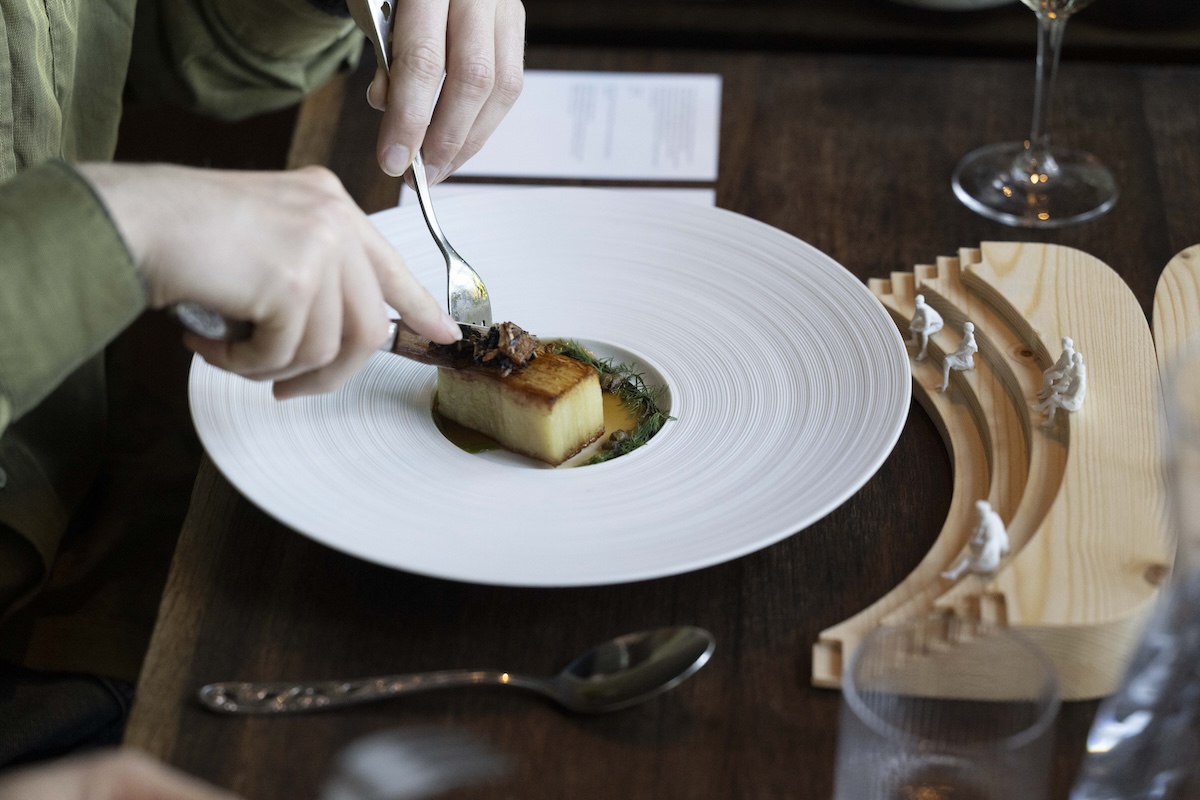
Architectural models: Hannes Frey
Production: Karen Eide Bøen, Sigrid Aakvik
Co-production: Bergen Internasjonal Teater, Carte Blanche
Supported by: Art Council Norway, Bergen Kommune
A piece for a choir and a cooking team that can be performed in restaurants, canteens or beer gardens. It advocates for tenderness, tolerance and listening to each other, while stretching the importance of personal opinions in a dialogue. The work relocates the stage on dining tables while the choir sings the story of two people whose names, ages and professions are unknown. Are they a couple? Old friends? Colleagues on a team-building exercise? Lovers? Cousins? A mother and daughter? An uncle and his nephew? We won’t know who they are, but they are in the audience for three interconnected shows, each of which explores tradition through a critical lens. As with most theatregoers, they engage in conversations of varying depth before and after the performances.
The performances they watch take place on the audience’s plate (three courses prepared by the chef and his team, each one reflecting one of the shows being discussed by our fictional pair); Mario & Raoul takes place throughout the dining area, with a choir singing the conversations of the two main characters in glorious four-part harmony.
In a time divided between the urge to advance and the need to preserve, this piece takes its stand with the most innocent traditions; those too slight to be argued over, that live without defence and disappear without resistance.
This complex yet intuitive dramaturgical situation enables the audience to become the primary structural components of the piece through conversation, social dynamics, and shared attention. It destabilises the roles of spectator, artwork and situation. Is theatre what is planned, what is performed, or what emerges?
The format blends social choreography, the rituals of a shared meal, and musical interventions, minimalist in style, but loud in volume. Within this hybrid form, a meta-theatrical space opens up where audience members function simultaneously as participants, witnesses, performers, and material. The piece explores how art can arise from everyday actions and how a theatrical experience can be rooted in both communal presence and produced artistic elements.